A finished job should lead to one thing: getting paid.
Learn how to write a professional invoice that is clear, easy to pay, and less likely to be delayed. See what to include, how to set payment terms, and simple ways to help clients pay faster.

But for a lot of freelancers, contractors, and small business owners, sending the invoice is only the beginning of the wait.
Recent Xero Small Business Insights data shows that U.S. small businesses waited an average of 29.3 days to be paid in the June quarter of 2026. Even when an invoice had a due date, payments still arrived an average of 8.5 days late.
That is a long time to wait for money you have already earned.
A good invoice cannot guarantee that every client will pay on time. But a clear, professional invoice removes excuses, reduces confusion, and makes it easier for your customer to pay.
Here is how to write an invoice properly, what to include, and a few simple changes that can help you get paid faster.
What Is an Invoice?
An invoice is a document you send to a customer requesting payment for products or services you have provided.
It tells the customer what they are paying for, how much they owe, when payment is due, and how they can pay you.
A professional invoice also gives both you and your customer a clear record of the transaction.
For freelancers and small businesses, that record becomes especially important when you are tracking unpaid invoices, preparing financial records, or resolving a payment question later.
What Should You Include on an Invoice?
A professional invoice does not need to be complicated.
It just needs to make the important information easy to find.
PayPal and Xero both recommend including business information, customer details, invoice numbers, dates, itemized goods or services, payment terms, taxes where applicable, and the amount due.
Here is what that looks like in practice.
Your Business Information
Include:
Your business name or your full name
Business address
Phone number
Email address
Website, if applicable
Business logo, if you use one
The customer should immediately know who sent the invoice.
Your Customer's Information
Include:
Customer name
Company name, if applicable
Billing address
Contact person
Department or accounts-payable contact, when needed
This becomes particularly important when invoicing larger companies.
Sending an invoice to the person who hired you does not always mean it has reached the person responsible for paying you.
A Unique Invoice Number
Every invoice should have its own number.
For example:
INV-2026-001
INV-2026-002
INV-2026-003
A simple numbering system makes invoices easier to track for both you and your customer.
If someone contacts you six months later about a payment, you can refer to the invoice number instead of searching through old emails trying to figure out which job they mean.
Invoice Date
Include the date the invoice was issued.
This establishes when the payment period begins.
Payment Due Date
Do not make your customer calculate the due date.
Instead of writing only:
Net 15
consider also displaying the actual date:
Payment Due: October 15, 2026
Make the deadline easy to see.
Description of Products or Services
Clearly desc
ribe what the customer is paying for.
Avoid vague descriptions like:
Consulting - $2,000
A better description might be:
Website design consultation - 10 hours at $200/hour
Clear descriptions reduce questions and make it easier for the customer or accounting department to approve the invoice.
Quantity and Rate
Where appropriate, show:
Quantity
Number of hours
Unit price
Hourly rate
Individual line total
The customer should be able to understand how you reached the final amount.
Subtotal, Taxes, Discounts and Total
Clearly separate:
Subtotal
Discounts
Taxes
Additional fees
Amount already paid
Final balance due
The amount the customer needs to pay should be one of the easiest numbers to find on the invoice.
Payment Instructions
Tell the customer exactly how to pay you.
Depending on your business, that might include:
Bank transfer
ACH
Credit or debit card
PayPal
Stripe payment link
Check
Online payment link
QR code
The fewer steps your customer has to take, the easier it becomes to pay you.
How to Write an Invoice That Gets Paid Faster
Including allthe required information is the starting point.
But a few details can make a noticeable difference in how smoothly the payment process goes.
1. Choose Clear Payment Terms
Payment terms tell your customer how long they have to pay.
Common examples include:
Due on receipt
Net 7
Net 15
Net 30
Net 60
Net 30 simply means payment is due within 30 days of the invoice date.
But Net 30 is not automatically the best choice for every business.
Stripe notes that Net 15 can work well for regular, lower-value projects because it gives customers time to pay without forcing the business to wait too long.
For smaller jobs, you may decide that Net 7, Net 15, or due on receipt makes more sense.
For larger companies, however, you may need to work within their established payment schedule.
The important thing is to agree on the terms before the invoice arrives.
2. Make Paying Easy
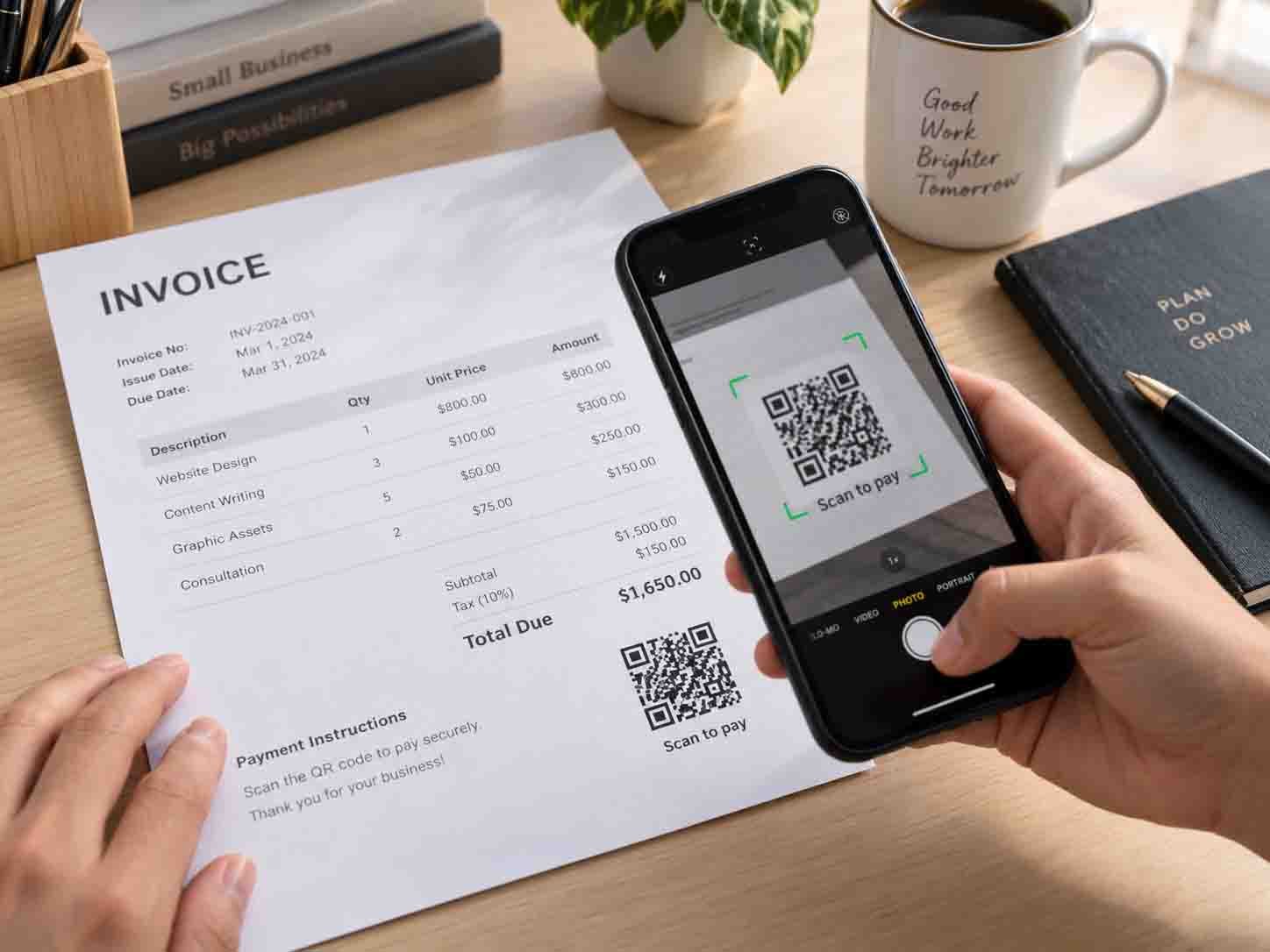
One of the easiest waysto create unnecessary payment delays is to make your customer work too hard to pay you.
Imagine receiving an invoice and then having to:
Find the sender's bank details.
Log into online banking.
Create a new recipient.
Enter account information.
Enter the invoice number.
Double-check everything.
Come back later because you got interrupted.
Every extra step gives the invoice another opportunity to be forgotten.
A direct payment link removes much of that friction.
Xero recommends including an online payment option or Pay Now button so customers can pay directly from the invoice.
If you use PayPal or Stripe, for example, you can include a payment link.
A QR code can make the process even easier when the customer is viewing a printed invoice.
Zahpy Pro allows you to add your payment link and generate a QR code for your invoice, giving customers a direct route from receiving the invoice to making payment.
3. Send the Invoice Immediately
Do not finish the job on Monday and wait until the end of the month to send the invoice.
The work is fresh in the customer's mind today.
Invoice today.
Xero recommends sending invoices as soon as the work is completed or the product is delivered.
The sooner the invoice goes out, the sooner the payment clock starts.
For different businesses, that could mean:
Contractors invoice when the job is completed
Freelancers invoice when a deliverable is approved
Photographers invoice after the agreed milestone
Consultants invoice according to project stages
Product businesses invoice at sale or delivery
Waiting to invoice only adds more time before you get paid.
4. Make the Due Date Easy to See
A due date should never be hidden inside a paragraph of terms.
Give it a clear place on the invoice.
For example:
Invoice Date: September 30, 2026
Payment Due: October 15, 2026
Amount Due: $1,250.00
Your customer should be able to look at the invoice for a few seconds and know exactly how much they owe and when you expect payment.
5. Use Specific Line Items
Compare these two descriptions.
Consulting Services - $1,500
and:
Brand strategy consultation - 6 hours at $250/hour - $1,500
The second description answers questions before they are asked.
This is especially useful when the person paying the invoice is not the same person who hired you.
An accounts-payable employee may have no idea what "consulting services" refers to.
Specific descriptions make invoices easier to approve.
6. Follow Up Before the Invoice Becomes a Problem
Sending an invoice does not mean you have to disappear until it becomes overdue.
A simple reminder shortly before the due date can help keep the invoice visible.
A practical reminder schedule might look like this:
A Few Days Before the Due Date
Send a friendly reminder.
Something as simple as:
Just a quick reminder that Invoice #1042 is due on October 15. I've attached another copy for convenience.
On the Due Date
Send a short confirmation that payment is due.
After the Due Date
Follow up politely but directly.
Include:
Invoice number
Amount due
Original due date
Payment link
Copy of the invoice
You do not need a long email.
Make it easy for the customer to understand what is outstanding and how to resolve it.
Common Invoice Mistakes That Can Delay Payment
Sometimes the problem is not the customer.
It is the invoice.
Here are several mistakes worth avoiding.
Sending the Invoice Too Late
If the work is finished, send the invoice.
Waiting until the end of the week or month unnecessarily extends the time before payment arrives.
Forgetting the Invoice Number
A unique invoice number makes the document easier to identify, track, and reference.
This becomes especially important when dealing with companies that process large numbers of invoices.
Using Vague Descriptions
"Services rendered" may be technically correct, but it tells the customer very little.
Describe the actual work.
Hiding the Due Date
Your customer should not need to search through the invoice to find out when payment is expected.
Making Payment Complicated
If you accept online payments, give the customer a direct way to use them.
A clickable payment link or QR code is far easier than asking the customer to search through an email for instructions.
Sending the Invoice to the Wrong Person
Before starting a larger project, ask:
Who should receive the invoice?
What email address should I use?
Do you require a purchase order number?
Is there anything your accounts department requires on the invoice?
Five minutes spent asking these questions can prevent weeks of delay.
Adding Late Fees Without Clear Terms
If you charge late fees, make sure the policy is clearly communicated and consistent with your agreement and applicable laws.
Do not surprise a customer with a fee that was never mentioned.
Example of a Simple Professional Invoice
A basic invoice might contain:
Invoice #1042
Invoice Date: September 30, 2026
Payment Due: October 15, 2026
From:
Carter Design Studio
123 Main Street
Baltimore, MD
hello@example.com
Bill To:
Acme Company
Accounts Payable
456 Market Avenue
Washington, DC
Services:
Logo Design - $750.00
Brand Guidelines - $500.00
Subtotal: $1,250.00
Tax: $0.00
Total Due: $1,250.00
Payment Terms: Net 15
Payment Method: Pay online using the payment link or QR code included with this invoice.
Thank you for your business.
That is enough.
A good invoice does not need to look complicated.
It needs to be clear.
How to Write an Invoice: Quick Checklist
Before sending your next invoice, check that it includes:
Your business name and contact details
Customer name and billing details
Unique invoice number
Invoice date
Clear payment due date
Itemized products or services
Quantities and rates
Subtotal
Taxes or discounts where applicable
Total amount due
Payment terms
Accepted payment methods
Online payment link where available
QR payment code where useful
Then send it as soon as the work is complete.
Final Thoughts
Writing an invoice is not difficult.
The goal is simply to remove uncertainty.
Your customer should immediately understand:
Who is asking for payment.
What they are paying for.
How much they owe.
When the payment is due.
How they can pay.
When those five things are obvious, there is less room for confusion and fewer reasons for the invoice to sit untouched.
And if you would rather not build every invoice manually, Zahpy Pro gives you a simple way to create professional invoices, export them as PDFs, and include payment links without depending on a monthly subscription.